
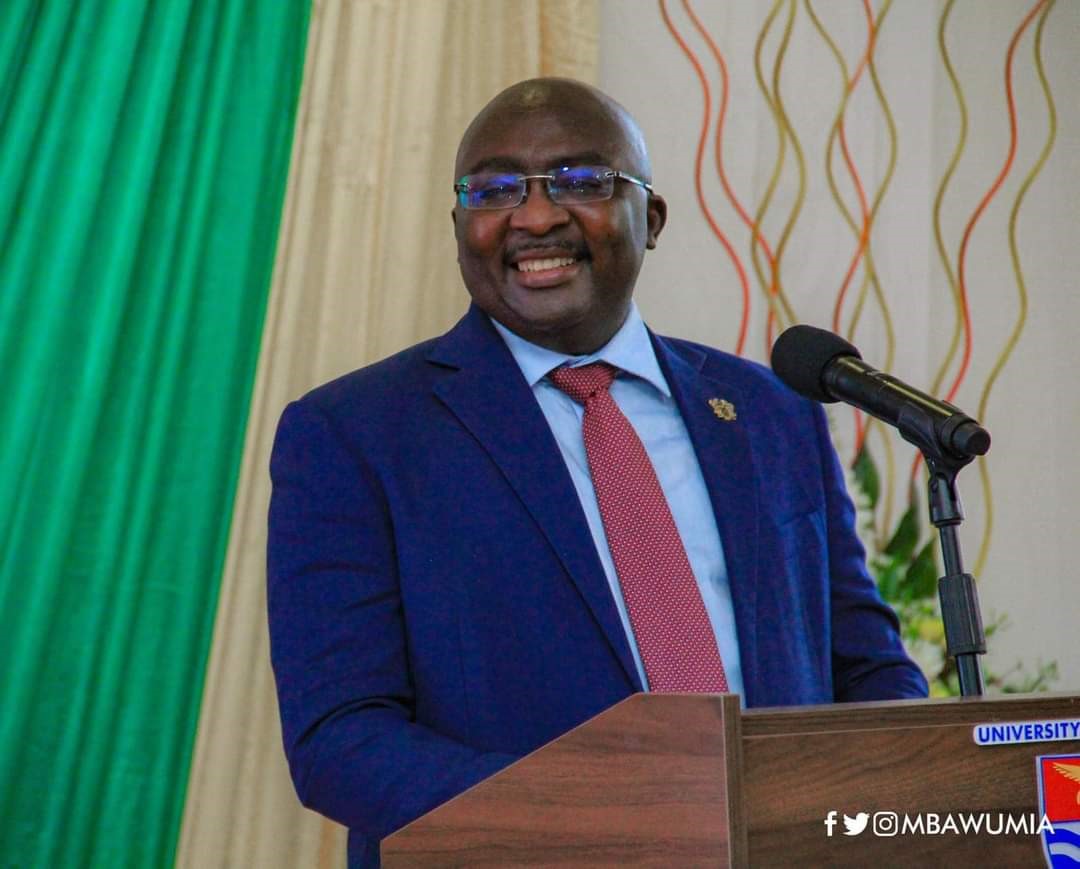
The Vice President, Dr. Mahamudu Bawumia has revealed that the impact of Covid-19 shows Ghana’s educational system needs a paradigm shift of adopting a digital approach in teaching and learning in the schools.
Dr. Bawumia said since the advent of Covid-19, much emphasis has been placed and focused on utilsing the digital space by the various tertiary and other institutions across the country to reach out to students through the online platforms which has s proven to be effective and beneficial in many grounds.
“Digitization has become the protagonist for change in the education sector and a massive drive from the Ghana card to mobile money interoperability and many others which are currently being rollout,” he stated
Dr. Bawumia made these comment on Monday February 14, 2022 during the launched of an Integrated Online Learning Programme (IOLP) offering over 3,000 free certificate courses and industry attachment for the youth as well as professionals at Legon.
The integrated online Learning Programme is a combined effort between the Alison, Leyden Educational Foundation and SOLNetwork. The program is expected to offer some 3000 courses certificate courses to youth and members of the Ghanaian society.
He Ghana is on the move to improve the efficiency by which we govern ourselves adding that the need for digital inclusion has never been so important than now
Speaking at the launch, the Executive Director of the Leyden Educational Foundation Dr. James Owusu said “formal and informal education systems must place a premium in quality education. Greater investment is needed in higher education vocational training, and skills acquisition.”
He further added that integrated Competency-based Online learning will bridge the skills gap between the various diversities across the populace in Ghana.


The Integrated Online Learning Program will be run by the University of Ghana in collaboration with international partners including Alison, Leyden Educational Foundation and SOLNetwork.
The Executive Director of Leyden Educational Foundation, Dr. James Owusu said the programme is a partnership with University of Ghana, Alison Republic of Ireland and Leyden Consultancy UK, SOLNetwork and Leyden Foundation Ghana.
Dr. Owusu said education promotes employment, earnings, health, and poverty reduction adding that globally, there is a 9% increase in hourly earnings for every extra year of schooling.
He said Ghana’s effort of Free Senior High School policy has seen more children are now in school adding that more children get to school, pressure on resources would increase and the quality of education sometimes is compromised.
Making smart and effective investments in people’s education is critical for developing the human capital that will end extreme poverty. At the core of this strategy is the need to tackle the learning crisis, put an end to Learning Poverty, and help youth acquire the skills they need to succeed in today’s world.
Dr. Owusu revealed that the learning poverty indicator, created by the World Bank and UNESCO Institute of Statistics launched in 2019, gives a simple but sobering measure of the magnitude of this learning crisis: the proportion of 10-year-old children that are unable to read and understand a short age-appropriate text.
In 2019, before Covid-19 hit, an alarming 53% of children worldwide failed to reach this basic bar of proficiency in reading and comprehension, putting the Sustainable Development Goal 4 targets in jeopardy. In Sub-Saharan Africa, the figure reached up to 90% in many countries.
He said Ghana is faced with 12% youth unemployment and more than 50% underemployment, both higher than overall unemployment rates in Sub-Saharan African countries. Despite major investments by both government and private sector, this challenge will intensify if job opportunities remain limited.
The Executive Director said nearly 50% of all candidates who participated in the 2021 West Africa Senior School Certificate Examination (WASSCE) failed the two key core subjects required to secure admission to the university with almost 40% of employers say a lack of skills is the main reason for entry-level vacancies.
To bridge this skills gap, “today we are launching the Integrated Competency Based Online learning using cutting-edge instructional delivery methods.”
The courses are innovative tuition free programme which offers qualifications to a vast number of people, especially to those who would not otherwise be able to afford to pay for their desired courses.
“In principle, this is a good idea in that it gives equality of opportunity to the underprivileged to obtain qualifications, as long as potential participants have the resources to access the programmes. The good news is that, in collaboration with University of Ghana Computer Systems, young people who do not have access to computers, internet, electricity etc can access the programme.
The training, he said is tailored to meet the needs of the local community in line with the government’s economic agenda. “We proposed to train 2000 youth across the country every year. The number of youth trained at each region will be based on the population dynamics of each region. A skill gap analysis will be done to identify the skill needs within the local area. The training needs will also be in line with the national economic agenda for sustainable growth.”